Ecosphere
- commission
- IRCAM
- premiere
- March 2002, Ensemble Intercontemporain, Patrick Davin cond., Centre George Pompidou, Paris, France
- length
- 30 minutes
- date
- 2001/2002
- instrumentation
- flute (pic, alto), oboe (cor anglais), clarinet (bass), clarinet 2 (contrabass), 2 horns, trombone, 2 keyboards, 2 percussion, 2 violins, viola, cello, bass, audio signal processing and spatialization
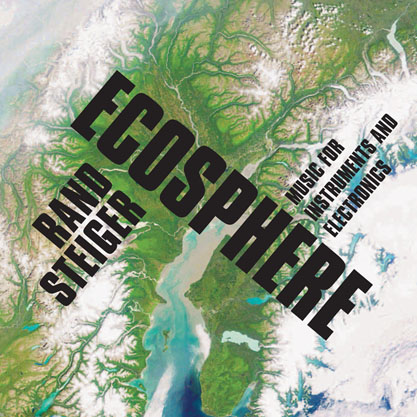
Program note:
The earth has a complex and delicate balance of ecosystems that sustain a diversity of life forms. Human intervention is now altering this balance in unprecedented ways, most notably from rain forest eradication, and the various effects of global warming. The geographer Robert Bailey has classified terrestrial ecosystems into four domains (polar, humid temperate, dry, and humid tropical) divided into 15 regions. All of the earth’s land mass falls into these 15 classifications in various percentages, from savanna (17%) to hot continental (1.4%). This is a dynamic equation that human intervention is altering quickly and dangerously.
This piece draws on Bailey’s classifications as a formal model. There are sixteen sections (in one continuous movement) that take their temporal proportions from the percentages of their corresponding ecosystem, presented in the following order (with cities given as one example of where each ecosystem may be found):
- atmosphere
- subarctic (Fairbanks)
- tundra (Reykjavik)
- warm continental (Tallinn)
- temperate steppe (Volgograd)
- marine (Paris)
- hot continental (Nagano)
- mediterranean (San Diego)
- tropical steppe (Khartoum)
- tropical desert (Djibouti)
- rain forest (Manaus)
- savanna (Madras)
- temperate desert (Tashkent)
- subtropical (Sydney)
- prairie (Montevideo)
- icecap (Byrd Station)
Some data about each region’s climate is taken into consideration in developing the material for each section, particularly the way temperature and precipitation change over the course of an average year. But other than this, the music is composed freely, with no attempt to illustrate. I do not seek to create a musical picture of these systems, but rather use this data as a model for a journey through a varied musical terrain. I also wish to celebrate the present diversity of ecosystems, and lament the gradual erosion of this diversity and corresponding extinction of numerous life forms.
Ecosphere is scored for flute (with piccolo and alto), oboe (with cor anglais), 2 clarinets (with bass, and contrabass), two horns, trombone, 2 percussionists, 2 keyboards, and string quintet. The keyboards control sample players to simulate various plucked and struck instruments, with a computer deployed to dynamically retune the samples in a just relationship to the fundamental frequency of each phrase. Real-time audio signal processing is deployed on all of the other instruments for spatialization, resonance, reverberation, delay, cross synthesis, and just intonation pitch shifting.
Ecosphere was commissioned by IRCAM. I wish to express my gratitude to Eric DeVischer and Allain Jaquinot for their support, to Miller Puckette of UCSD for his software development, and to Olivier Pasquet of IRCAM for his indispensable assistance with the technical realization of this work.
On the morning of 11 September 2001 a terrible act of cruelty occurred in my place of birth, New York City. Perhaps a work of art seems trivial in light of the disastrous consequences of this act. But however insignificant it may seem, I must offer this piece in dedication to the memory of the victims of this tragedy.